
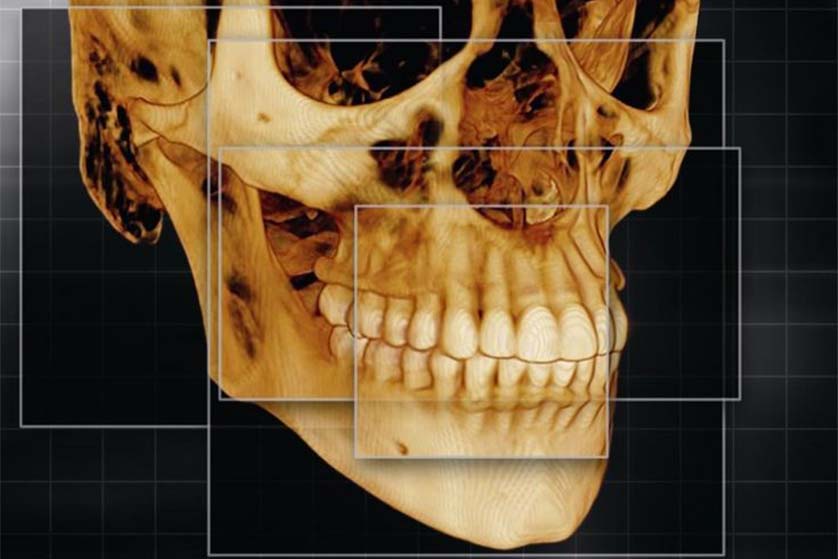
A dental CBCT (cone beam computed tomography) scan is a 3D X-ray of your teeth and jaws. Where an ordinary dental X-ray gives a flat picture, a CBCT shows the bone, roots, nerves and sinuses in three dimensions, so your dentist can measure them and plan treatment precisely. It is most often used before dental implants, and also for difficult wisdom teeth, complicated root canal problems and some orthodontic cases.
What is a CBCT scan in dentistry?
During a CBCT scan, an X-ray source and a detector rotate once around your head. The machine takes a series of images from different angles, and a computer combines them into a 3D model. Your dentist can then look at any part of that model from any direction, take thin slices through it, and measure distances and angles.
The name describes how it works: the X-ray beam is shaped like a cone, so the whole area of interest is captured in one rotation. People also call it a 3D CBCT scan, a dental CT scan or simply a tooth scan.
How is CBCT different from an ordinary dental X-ray?
The small X-rays taken in the chair, and the panoramic X-ray (OPG) that shows the whole mouth on one strip, are two-dimensional. They are quick, useful and often all that is needed, but they flatten everything onto one plane. Structures overlap, and you cannot see the width of the bone or exactly where a nerve runs from front to back.
A CBCT adds that third dimension. It can show:
- the height, width and shape of the jawbone where an implant is planned
- the path of the nerve in the lower jaw and the position of the sinus above the upper back teeth
- the exact relationship between a wisdom tooth's roots and the nerve
- extra or curved root canals, cracks and infections at the root tip that a flat X-ray can miss
- teeth that have not come through, and their position relative to neighbouring roots
How is dental CBCT different from a hospital CT scan?
A medical CT scanner is a large ring you lie inside, designed to image the whole body, including soft tissues such as organs. A dental CBCT machine is much smaller, you usually sit or stand, and it is designed for the teeth, jaws and face. For dental purposes it generally gives very detailed images of bone and teeth with a lower radiation dose than a conventional medical CT. It is not designed to show soft tissue in detail, so it does not replace medical imaging when a doctor needs that.
When does a dentist need a CBCT scan?
Dental implants
This is the most common reason, and why many people search for a dental implant clinic with a CBCT scan. Before an implant, the dentist needs to know whether there is enough bone, how dense it is, and how close the nerve or sinus is. The scan shows whether a bone graft or sinus lift is needed and lets the implant be planned on screen, in the right position for the final tooth, before surgery begins. For full-mouth treatment and zygomatic implants, which anchor in the cheekbone, 3D planning is essential.
Wisdom teeth
When an X-ray suggests that a lower wisdom tooth sits close to the nerve, a CBCT shows exactly how close, and in which direction. That helps the dentist or oral surgeon judge the risk and plan the safest approach.
Root canal problems
Most root canal treatment needs only ordinary X-rays. A CBCT can help when the anatomy is complicated, when a previously treated tooth is still causing trouble, when a crack or a hidden canal is suspected, or when a flat X-ray does not explain the symptoms. Read more about root canal treatment.
Orthodontics
For teeth that are buried or have not come through, such as an impacted canine, a CBCT shows where the tooth lies and whether it is affecting neighbouring roots. It can also help plan more complex aligner and brace treatment.
Other uses
Dentists may also use CBCT to look at cysts or other changes in the jaw, injuries to the teeth and jaws, some sinus findings near the upper teeth, and the jaw joint.
What is a CBCT scan like?
For most people it is quick and straightforward.
- You remove anything metal around the head and neck: earrings, necklaces, glasses, hairpins, hearing aids and removable dentures or braces, because metal can blur the image.
- You sit or stand in the machine. A chin rest, a small bite block or head supports help you keep still.
- The arm rotates once around your head. The rotation itself is brief, usually well under a minute, and you need to stay as still as you can while it moves.
- The images are reconstructed on a computer and are ready for your dentist to examine.
There is no injection, no dye and no enclosed tunnel, so people who find hospital scanners uncomfortable usually manage a CBCT without difficulty. It does not hurt.
Is a CBCT scan safe? What about radiation?
A CBCT uses X-rays, so it does involve radiation. The dose is generally more than a single small dental X-ray and less than a conventional medical CT of the same area. The guiding principle in dentistry is that a CBCT is used only when the extra detail is likely to change the diagnosis or the treatment, not as a routine check-up. The area scanned should also be kept as small as the question allows.
Some practical points:
- Tell the dentist if you are, or might be, pregnant. Non-urgent scans are usually postponed.
- Children are more sensitive to radiation, so scans for them are used even more selectively.
- If you have had a recent CBCT elsewhere, bring the files. If it covers the right area and is of good quality, it may avoid a repeat.
If you are unsure why a scan has been recommended, it is reasonable to ask what your dentist expects it to show and how it will affect the plan.
What happens after the scan?
The scan is a 3D data set, not a single picture. Your dentist reviews it slice by slice, in all three planes, and for implants often plans the implant directly on it. The whole volume should be checked, not only the tooth in question, because a scan can show findings elsewhere in the jaw that need attention. You can ask to see the images and have them explained, and to receive a copy of the files for your records.
CBCT at Sterling
At The Sterling Dental Clinic in Vasant Vihar, every dental implant is planned on a 3D CBCT scan before it is placed, so the bone, nerves and sinus are mapped and the implant position is decided before treatment. A full CBCT 3D scan is ₹10,000, and it is listed separately in your quote. Read more about dental implants at Sterling.
Common questions
How much does a CBCT dental scan cost?+
At The Sterling Dental Clinic, a full CBCT 3D scan is ₹10,000, confirmed at your consultation. Your dentist should explain why the scan is needed and what it will be used to decide. When you are planning dental implants, check whether a clinic's implant price includes the scan or lists it separately, so you can compare quotes fairly.
Do I need a CBCT scan for one dental implant?+
A 3D scan is widely recommended before implants because a flat X-ray cannot show the width of the bone or exactly where the nerve and sinus lie. These measurements decide the implant size and position and whether grafting is needed. At Sterling, every implant, including a single one, is planned on a CBCT scan before it is placed.
Can a CBCT scan show a tooth infection?+
A CBCT can show changes in the bone around a root tip that suggest infection, sometimes earlier or more clearly than an ordinary X-ray. It can also help reveal a missed canal or a crack. The scan is one part of the diagnosis; your dentist combines it with your symptoms and an examination before deciding whether treatment is needed.
Can I use a CBCT scan taken at another clinic?+
Often, yes. If the scan is recent, covers the area being treated and is of good quality, your dentist may be able to plan from it and avoid a repeat. Ask the other centre for the full data files, not only printed images or a report, because the 3D files are what allow measurement and planning on screen.
Is a CBCT scan suitable during pregnancy?+
Dental scans are usually postponed during pregnancy unless they are urgently needed, because any unnecessary radiation is avoided at that time. Always tell your dentist if you are pregnant or think you might be. If you have dental pain during pregnancy, see a dentist anyway: many problems can be examined and treated safely, and they will decide what imaging, if any, is needed.
This article is general information, not a diagnosis. Your own treatment plan is agreed after an examination at the clinic.