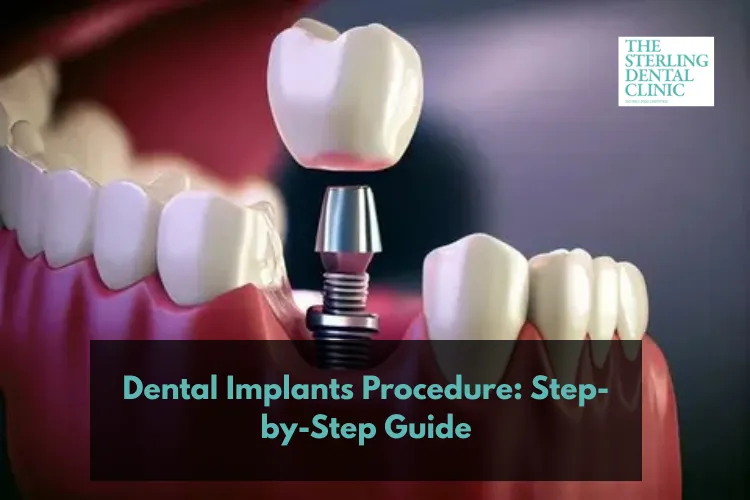
The dental implant procedure has three main stages: a consultation with a 3D CBCT scan to plan the implant, a short surgery under local anaesthesia to place a titanium or ceramic post in the jawbone, and, after a healing period of usually a few months, an abutment and crown that become your new tooth. Some people also need an extraction or a bone graft first. Here is each step in order, with honest answers about pain, timing and recovery.
What is a dental implant?
A dental implant is a small screw-shaped post, usually made of titanium, that replaces the root of a missing tooth. Over the weeks after surgery the bone grows closely around it, a process called osseointegration. Once it is firm, a connector called an abutment is fitted on top, and a crown is attached to the abutment.
The result is a fixed tooth that does not rest on the gum and does not need the teeth on either side to be cut down, as a bridge does. One implant can replace one tooth, two or more implants can support a bridge, and four to six implants can hold a full arch of fixed teeth.
Dental implants step by step
Step 1: Consultation and CBCT scan
Your dentist examines your teeth, gums and bite, and asks about your general health and medicines. Conditions such as uncontrolled diabetes, smoking, active gum disease and some medicines that affect bone can change the plan, so mention everything, even if it seems unrelated.
A CBCT (cone beam CT) scan gives a 3D picture of the jaw. It shows the height, width and quality of the bone, and the position of the nerve in the lower jaw and the sinus above the upper back teeth. This is what tells the dentist whether an implant is possible, what size it should be, and whether grafting is needed. An ordinary flat X-ray cannot show bone width at all.
Step 2: Treatment planning
The implant position is planned on the scan before surgery, with the final tooth in mind: where the crown needs to sit determines where the implant goes. You should come away from this stage knowing:
- how many implants you need and where
- which implant system is suggested, and why
- whether you need an extraction, a bone graft or a sinus lift
- what you will wear in the gap while the implant heals
- the likely timeline and a written quote
In some cases a surgical guide is made from the plan. It fits over the teeth or gum during surgery and directs the drill to the planned position and angle.
Step 3: Extraction, if a tooth is still there
If the tooth being replaced is still present, it is removed first. Depending on the bone and any infection, the implant may be placed at the same appointment (immediate placement) or the socket may be left to heal for some weeks first. The scan and the condition of the socket on the day decide this.
Step 4: Bone grafting or sinus lift, if needed
Bone shrinks after a tooth is lost, and gum disease can also reduce it. If there is not enough bone to hold an implant securely, graft material is added to rebuild the area. Small grafts are often done at the same time as the implant. Larger grafts may need to heal for several months before the implant can go in.
In the upper back jaw, the floor of the sinus can sit close to the bone ridge. A sinus lift gently raises the sinus lining and places graft material underneath to make room for the implant. Not everyone needs grafting, and your scan will show whether you do.
Step 5: Implant placement surgery
This is the step most people mean when they search for dental implant surgery. It is done under local anaesthesia, the same kind of injection used for a filling, so the area is fully numb. The dentist makes a small opening in the gum, prepares a precise channel in the bone and places the implant. The gum is then closed over or around it, sometimes with a few stitches.
For a single implant in straightforward bone, the surgery itself is often shorter than people expect, frequently under an hour. Multiple implants, grafting or full-arch treatment take longer. For anxious patients or longer procedures, sedation can be discussed in advance.
Step 6: Healing (osseointegration)
The implant now needs time to bond with the bone before it can take biting forces. This commonly takes around three to six months, and longer if a graft was placed. It varies with the bone, the site and your general health. You will not be left with a visible gap: a temporary denture, a bonded temporary tooth or, in suitable cases, a temporary crown on the implant itself is used meanwhile.
In suitable cases, when the implant is very firm in the bone on the day of surgery, a temporary tooth can be attached straight away. This is called immediate loading. It is not right for everyone, and it is decided on the scan and at surgery. See same-day implant crowns for when it may be possible.
Step 7: Abutment and crown
Once the implant is stable, the abutment is fitted. With some implants this needs a small second procedure to uncover the implant under local anaesthesia; with others the healing cap was visible from the start and the abutment simply replaces it.
A scan or impression is then taken, and the crown is made to match the shape and shade of your teeth. It is either screwed or cemented to the abutment, and the bite is checked and adjusted so the implant is not overloaded.
Step 8: Aftercare and check-ups
An implant cannot decay, but the gum and bone around it can become inflamed if plaque builds up, much like gum disease around a natural tooth. Regular check-ups and professional cleaning are part of the treatment, not an extra.
How long does the dental implant process take?
From the first consultation to the final crown, a single implant in good bone commonly takes a few months, most of it healing time rather than appointments. When a bone graft must heal first, the whole process can take longer. Full-arch treatment follows its own timeline; at Sterling, for example, full-mouth implants are planned as two visits, with fixed temporary teeth on the first and the final bridge after the implants have healed.
Is dental implant surgery painful?
During the surgery you should feel pressure and vibration, but not sharp pain, because the area is numb. If you feel anything sharp, say so: more anaesthetic can be given.
Afterwards, once the numbness wears off, some soreness, swelling and occasionally bruising are normal for a few days. Most people manage with the painkillers their dentist recommends, and many return to desk work within a day or two. Larger procedures, such as several implants or grafting, usually mean more swelling and a longer recovery. Pain that keeps getting worse after the first few days is not normal and should be checked.
Recovery and aftercare after implant surgery
The first few days
- Bite gently on gauze if there is oozing, and avoid spitting or vigorous rinsing on the first day.
- Use a cold pack on the cheek in short spells to limit swelling.
- Eat soft, lukewarm food and chew on the other side.
- Do not smoke or drink alcohol. Smoking slows healing and is a known risk to implants.
- From the next day, rinse gently with warm salt water or the mouthwash you are given, and brush the other teeth normally.
- Take any medicines exactly as prescribed.
When to call your dentist
- bleeding that does not settle with pressure
- swelling or pain that increases after the third day
- fever, a bad taste or discharge from the site
- numbness of the lip or chin that has not gone once the anaesthetic should have worn off
- a temporary tooth or healing cap that feels loose
Looking after it for the long term
Brush twice a day, clean around the implant with floss, interdental brushes or a water flosser as shown, and keep your check-up appointments. If you grind your teeth, a night guard protects both your implants and your natural teeth.
Who can have dental implants?
Most adults who have lost a tooth can be considered. Age on its own is rarely the barrier; general health, gum health, smoking and bone are what matter. Where bone is limited, grafting, shorter or angled implants, or zygomatic implants may still make fixed teeth possible. Only an examination and scan can tell you what applies to you.
Starting the process
At The Sterling Dental Clinic in Vasant Vihar, every implant is planned on a 3D CBCT scan before it is placed, using one of several international implant systems, which you can compare on our implant brands page. If you are missing a tooth or have been told one needs to come out, a consultation is the first step: you leave with your scan, a clear plan and a written quote. Read more about dental implants at Sterling.
Common questions
Is dental implant surgery done under general anaesthesia?+
Usually not. Most implant surgery is done under local anaesthesia, which numbs only the area being treated, so you stay awake and can go home the same day. For anxious patients or longer procedures, such as several implants or full-arch treatment, sedation can be discussed with your dentist in advance. General anaesthesia is reserved for particular situations and needs a hospital setting.
How many visits does the dental implant process need?+
For a single implant, expect a consultation and scan, the surgery, a short check after a week or two, and then one or two visits for the abutment and crown once healing is complete. Extractions, bone grafts or a sinus lift add visits. Full-arch treatment is planned differently, so ask your dentist for a visit-by-visit plan before you start.
Can I go back to work after dental implant surgery?+
Many people return to desk work the next day or the day after a single implant. Heavy physical work and exercise are best avoided for a few days because they can increase bleeding and swelling. After several implants or grafting, plan for a few quieter days. Your dentist will tell you what to expect for your own procedure.
What are the risks of dental implant surgery?+
As with any surgery, there can be infection, bleeding, swelling and bruising. Less commonly, the implant may not bond with the bone and need replacing, or nearby structures such as a nerve or the sinus can be affected. Careful planning on a 3D scan, good health control, not smoking and following aftercare advice all help reduce these risks.
What if I have too little bone for an implant?+
Low bone does not always rule implants out. A bone graft can rebuild the area, a sinus lift can make room in the upper back jaw, and shorter or angled implants can sometimes avoid grafting. When the upper jaw has very little bone, zygomatic implants anchored in the cheekbone may be an option. A CBCT scan shows which approach suits you.
This article is general information, not a diagnosis. Your own treatment plan is agreed after an examination at the clinic.