
Every year, patients fly to Delhi for dental implants from the UK, the USA, Australia, Canada and the Gulf. The reasons are usually the same: private implant fees at home run into thousands of pounds or dollars per tooth, waiting lists are long, and India has experienced implant surgeons working with the same implant systems used in Europe and America.
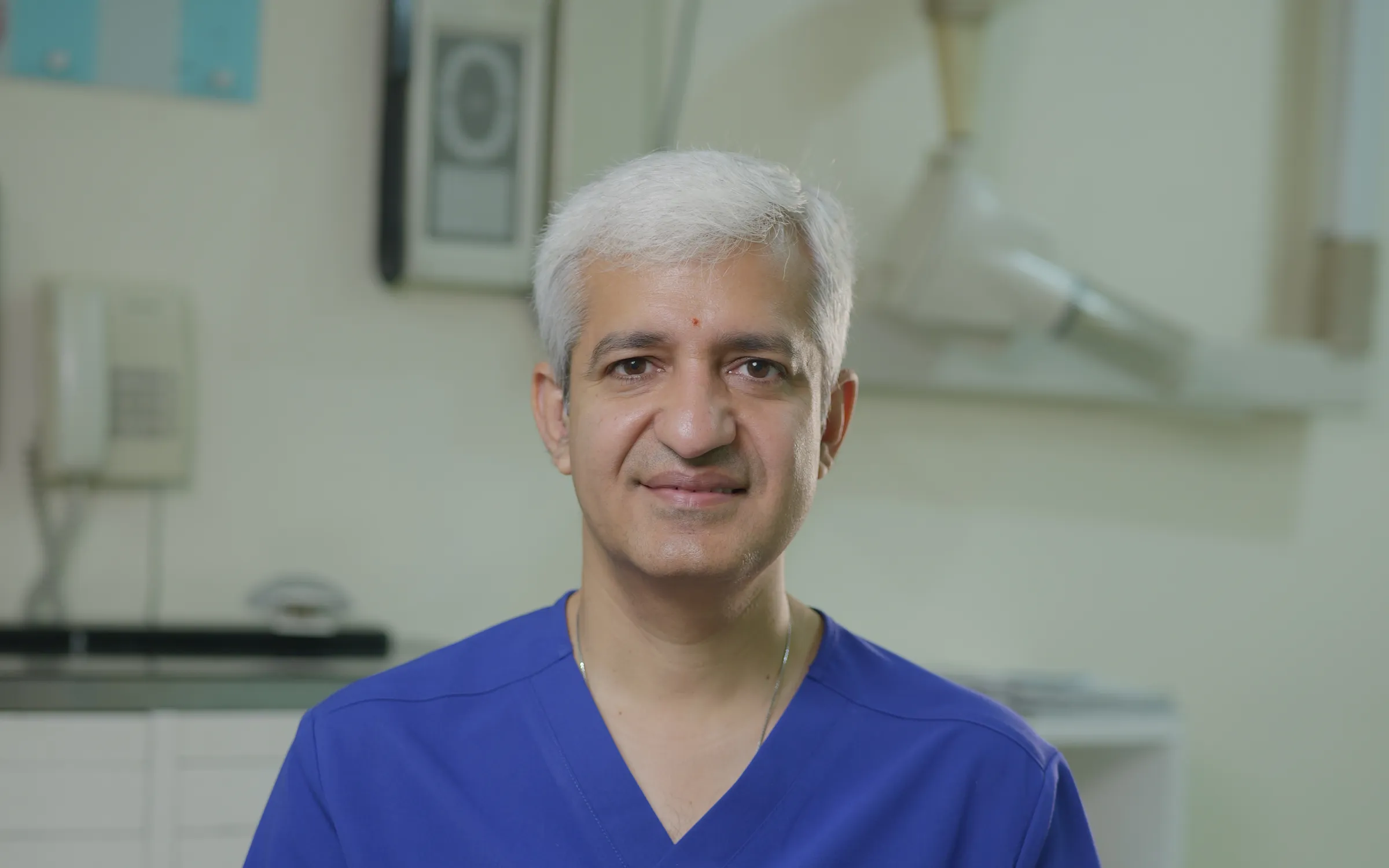
This guide explains how it actually works, from the first X-ray you send to the check-up after you are home. It is written by the team at The Sterling Dental Clinic in Vasant Vihar, New Delhi, where implant treatment is led by Dr. Tarun Kumar Giroti. Sterling reports patients from more than 97 countries and over 15,000 implants placed by its team.
Is travelling for implants right for you?
Implants suit most adults who are missing one or more teeth and are in reasonable general health. Travelling for them is a good idea when a few things are true:
- You can come for the time the plan needs (usually two trips, for single implants and for full-arch cases alike).
- Your general health is stable. Uncontrolled diabetes, heavy smoking, some bone medicines and recent radiotherapy to the jaw can all change the plan and need discussing first.
- You have, or can get, a recent X-ray (an OPG) or a CBCT scan to share before you travel.
- You have a dentist at home who can see you for routine check-ups afterwards.
How the treatment works, step by step
- 1
Share your X-rays
Send a recent OPG or CBCT and a short medical history on WhatsApp. The implant team replies with what looks possible and an indicative cost.
- 2
Video consultation
A call to talk through options, the number of trips and anything that needs checking first.
- 3
Scan and plan in Delhi
On arrival: examination, CBCT 3D scan and a digital plan of each implant's position.
- 4
Implant placement
Under local anaesthesia; sedation is available for anxious patients.
- 5
Healing
The implant bonds with the bone (osseointegration). For full-arch cases a fixed temporary bridge is fitted on the first trip, so you go home with fixed teeth.
- 6
Final teeth and records
On the second trip, a few months later, the final crowns or bridge are fitted, and you leave with your implant records for your dentist at home.
One trip or two?
This is the question that shapes your whole plan, so it is worth understanding early.
| Treatment | Typical number of trips | Time in Delhi |
|---|---|---|
| Single or a few implants | Usually two: placement, then the final crown after healing | About 3–5 days each trip |
| Full arch (All-on-4 / All-on-6) | Usually two: implants and a fixed temporary bridge, then the final bridge 3–6 months later | About 7–14 days, then about two weeks |
| Cases needing a bone graft or sinus lift | No extra trip if the graft is done with the implant; if the implant has to wait for the graft to heal, it is placed at a later stage | Depends on the graft |
Healing between trips usually takes a few months. Some patients time the second trip with a family visit or a holiday; others fly in for a short stay just for the crowns or the final bridge.
What it costs
Sterling quotes every case individually after the CBCT scan, because the number of implants, the implant system and any grafting all change the price. These are the clinic's indicative prices:
| Treatment at Sterling | Indicative price (INR) | Approx. GBP |
|---|---|---|
| Single implant, DIO (Korea) | ₹40,000–45,000 | ≈ £310–350 |
| Single implant, Alpha-Bio (Israel) | ₹45,000 | ≈ £350 |
| Single implant, Zimmer (USA) | ₹50,000 | ≈ £390 |
| Single implant, Nobel Biocare (Sweden/USA) | ₹60,000 | ≈ £470 |
| Single implant, Straumann (Switzerland) | ₹60,000 | ≈ £470 |
| Full-arch implants (All-on-4 / All-on-6) | ₹3,50,000–6,00,000 | ≈ £2,760–4,720 |
| Bone graft (when needed) | ₹10,000–20,000 | ≈ £80–160 |
| Sinus lift (when needed) | ₹40,000 | ≈ £310 |
| CBCT 3D scan (full) | ₹10,000 | ≈ £80 |
The implant prices above do not include the crown: a metal-ceramic crown is ₹15,000 and a zirconia crown ₹20,000, so a single implant with its crown at Sterling is ₹55,000–80,000 (≈ £430–630). For comparison, a single implant with its crown costs from £2,400 privately in the UK (Bupa Dental Care) and US$5,000–7,500 at a large US chain (ClearChoice). See our full cost guide for other countries, and for the costs people forget, such as flights, hotel and the second trip.
Choosing a clinic you can trust
The UK's dental regulator, the GDC, suggests that anyone considering treatment abroad checks who will treat them, asks about success rates, aftercare and guarantees, and keeps their own dentist informed (GDC guidance). It is good advice wherever you live. Ask any clinic:
- Who will place my implants, and how many have they placed?
- Which implant system will you use, and will I get its brand, size and batch details?
- Will you take a CBCT scan and plan the implants digitally before surgery?
- What exactly does the quote include, and what could be extra?
- What happens if something needs attention after I am home?
Our safety checklist goes through each of these in detail.
Visas and travel
Nationals of the UK, USA, Australia, Canada and the UAE can apply online for India's e-Medical visa. According to the official e-Visa portal, it is valid for a year from arrival with multiple entries, you apply at least four days (and up to 120 days) before you travel, and up to two companions can come on e-Medical Attendant visas. You need a letter from the treating clinic, which Sterling provides once your plan is agreed.
If you hold an OCI card, you do not need a separate visa for treatment (Consulate General of India). Always check the official portal before you apply, as rules change.
Sterling is in Vasant Vihar, about 12–13 km from Indira Gandhi International Airport's Terminal 3: roughly 15 to 45 minutes by road, depending on traffic (Rome2Rio).
Flying home after surgery
A review in the British Dental Journal suggests waiting at least 72 hours after implant placement before flying, and ideally about a week; after a sinus lift, at least two weeks and ideally six (Felkai et al., 2023). The evidence is limited, so your surgeon will advise on your own case. Build a few spare days into your plan.
Aftercare back home
Implants need the same care as natural teeth: brushing, cleaning between the teeth and regular check-ups. Your dentist at home can do those check-ups, as long as they know exactly what was placed. Before you leave Sterling you receive your implant records: the system and sizes used, your X-rays and scans, and what was fitted. If a question comes up later, the implant team can review photos or X-rays remotely.
Guides for your country
- Dental implants in India from the UK
- Dental implants in India from the USA
- Dental implants in India from Australia
- Dental implants in India from Canada
- Dental implants: Delhi vs Dubai, for NRIs and expats in the Gulf
- What dental implants cost in India, and what to budget for the trip
- Is it safe to get dental implants in India? A checklist
- What your dentist back home needs from us
- India's e-Medical visa, step by step
- Your virtual consultation: what to send us
- India vs Turkey vs Mexico vs Thailand
- Who should not travel for implants
- One trip or two? Immediate loading explained
- Bone grafts and sinus lifts
- All-on-4 vs All-on-6
- Flying after implant surgery
- Your Delhi trip: where to stay and recovery
Frequently asked questions
How long do I need to stay in India for dental implants?+
For a single implant, usually about 3–5 days per trip, with two trips a few months apart. Full-arch cases (All-on-4 or All-on-6) take two trips: about 7–14 days for the implants and a fixed temporary bridge, then about two weeks, 3–6 months later for the final bridge. Your exact plan is confirmed after your scan is reviewed.
Can I get my X-rays reviewed before I travel?+
Yes. Send a recent OPG or CBCT and a short medical history on WhatsApp. The implant team will tell you what looks possible, how many trips it is likely to take and an indicative cost.
Which implant brands does Sterling use?+
Sterling works with Straumann, Nobel Biocare, Alpha-Bio, DIO and Zimmer implants. Your records list the exact system and sizes, so a dentist anywhere can maintain them.
Do I need a medical visa?+
UK, US, Australian, Canadian and UAE nationals can apply online for India's e-Medical visa, with a letter from the clinic. OCI card holders do not need a separate visa. Check the official e-Visa portal before applying.
Can my dentist at home look after my implants?+
Yes. You leave with your implant records, including the system, sizes and X-rays, so your own dentist can carry out routine check-ups and cleaning.
How soon can I fly after implant surgery?+
Published guidance suggests at least 72 hours after implant placement, ideally about a week, and longer after a sinus lift. Your surgeon will advise on your case.
Sources
- General Dental Council: Going abroad for dental treatment (accessed 28 September 2026)
- Bupa Dental Care: Cost of dental implants (accessed 28 September 2026)
- ClearChoice: Dental implants cost guide (USA) (accessed 28 September 2026)
- Government of India: e-Visa (incl. e-Medical and e-Medical Attendant) (accessed 28 September 2026)
- Consulate General of India, San Francisco: General information on the OCI card (accessed 28 September 2026)
- Rome2Rio: IGI Airport Terminal 3 to Vasant Vihar (accessed 28 September 2026)
- Felkai et al. (2023), Dental tourism and the risk of barotrauma and barodontalgia, Br Dent J 234:115–117 (accessed 28 September 2026)
This guide is general information, not a diagnosis or treatment plan. Whether implants suit you, and what they will cost, depends on a clinical examination and 3D scan. Prices are indicative and are confirmed in writing before any treatment.