
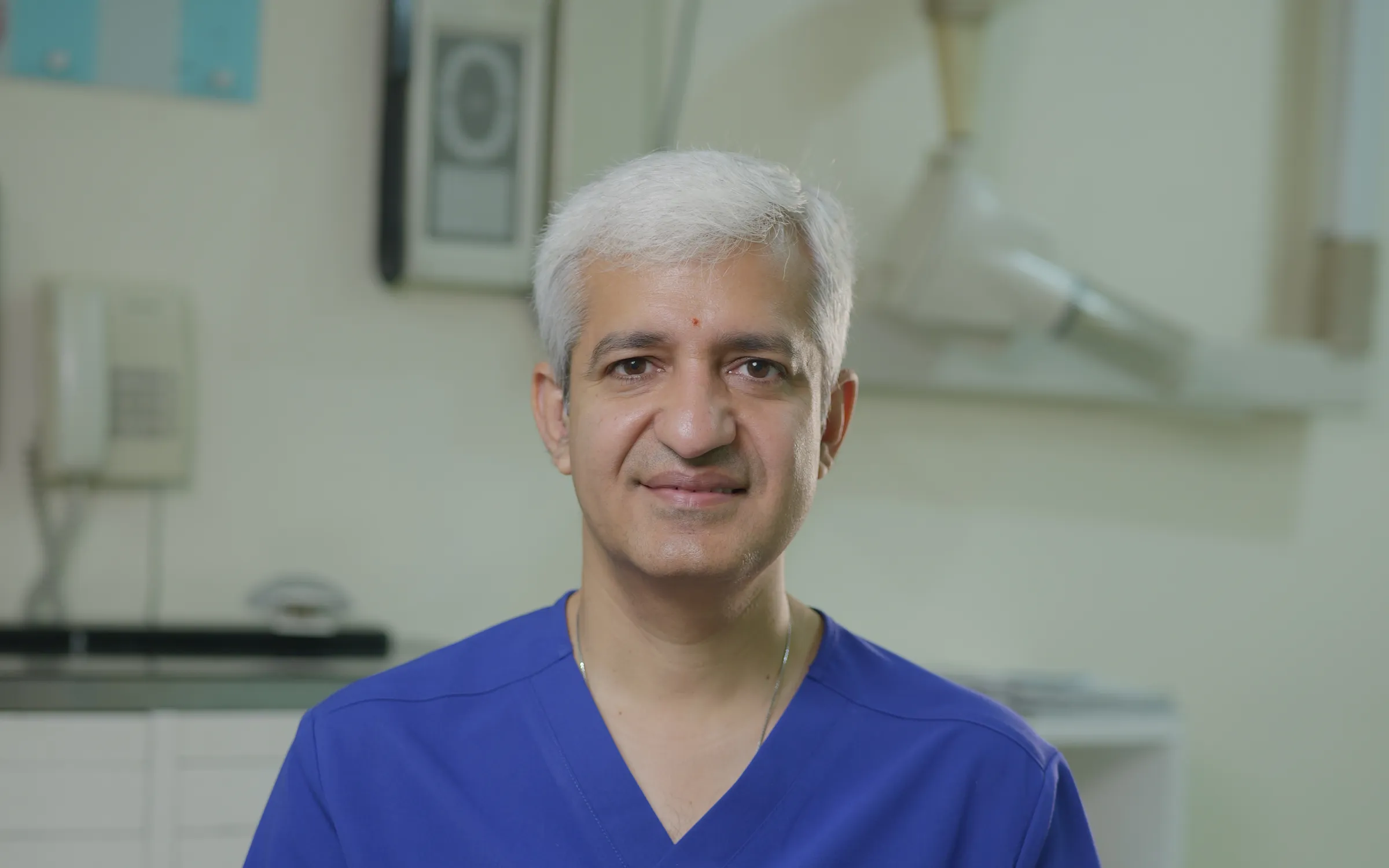
"How many implants will I need?" is one of the first questions patients ask, and many expect the answer to be "one for every missing tooth". It usually is not. In a short video, Sterling's implant team explains the difference between the two ends of the range: a single implant for one missing tooth, and All-on-4 for a whole arch. This guide covers those two and everything in between.
Watch · The Sterling Dental Clinic
Single Implant vs All-on-4 Dental Implants
Using a model of each, the clinic explains when a single implant is used, when All-on-4 is used, and why All-on-4 does not need an implant for every missing tooth.
43 s · Open on YouTube
Read what is said in the video
This is single tooth implant. This is All-on-4 implant. What is the difference?
When you are missing one single tooth, then a single implant is placed into the jawbone. We let it heal for a few months and a crown is fabricated to replace the missing tooth.
When you have multiple missing teeth or full arch of teeth missing, then All-on-4 is a solution. We don't place a single implant for each missing tooth. We place four implants in strategic positions and then fabricate bridge on top of it to replace the full arch of teeth.
So for a single missing tooth we use single implants. For multiple teeth which are missing or to replace a full set of teeth, we use All-on-4 implants.
The short answer
An implant replaces a tooth's root, not necessarily a whole tooth. One implant can hold one crown, or it can be one of the supports for a bridge of several teeth. So the number of implants depends on how many teeth are missing, where they are, how much bone there is and how hard you bite, and the final number is decided on your CBCT scan, not counted from the gaps.
| Your situation | Typical plan | What is fitted |
|---|---|---|
| One missing tooth | One implant | One crown |
| Two or three teeth missing side by side | One implant per tooth, or two implants holding a bridge | Separate crowns, or a small implant bridge |
| Most or all teeth missing in one jaw | Four implants (All-on-4) or six (All-on-6) | One fixed bridge for the whole arch |
| Loose lower denture, fixed teeth not wanted or not possible | Two or more implants under the denture | A removable denture that clips onto the implants |
One missing tooth: a single implant and crown
For a single gap, one implant is placed in the jawbone where the root used to be. As the video explains, "we let it heal for a few months and a crown is fabricated to replace the missing tooth." The teeth on either side are left alone, which is the main advantage over a conventional bridge, where the neighbouring teeth are usually shaped to hold it. Back teeth matter as much as front ones: a missing molar can let the teeth around it drift and change your bite over time.
| Treatment at Sterling | Indicative price (INR) |
|---|---|
| Single implant, DIO (Korea) | ₹40,000–45,000 |
| Single implant, Alpha-Bio (Israel) | ₹45,000 |
| Single implant, Zimmer (USA) | ₹50,000 |
| Single implant, Nobel Biocare (Sweden/USA) | ₹60,000 |
| Single implant, Straumann (Switzerland) | ₹60,000 |
| Crown, metal-ceramic (PFM) | ₹15,000 |
| Crown, zirconia full ceramic | ₹20,000 |
Several missing teeth: individual implants or an implant bridge
When two, three or four teeth are missing next to each other, there are usually two ways to do it:
- One implant for each tooth, each with its own crown. This needs enough bone at every position and means more implants.
- An implant bridge: for example, two implants at either end holding a bridge of three teeth. Fewer implants, less surgery, and it can avoid grafting where the bone in the middle is thin.
Which one suits you depends mostly on the bone along the gap, the space available, and how strongly that part of your mouth bites. The CBCT scan shows the bone at each position, which is why the plan is settled after the scan rather than before it. Our guide to what to know before an implant explains what the scan shows.
A full arch: All-on-4 and other full-arch plans
When most or all of the teeth in one jaw are missing, or cannot be saved, the approach changes. In the video's words: "We don't place a single implant for each missing tooth. We place four implants in strategic positions and then fabricate bridge on top of it to replace the full arch of teeth." The back implants are often angled so that they use the bone that is there, which in many cases avoids grafting.
Four is not the only number. When there is enough bone, six implants (All-on-6) may be chosen for extra support, for example with a strong bite. The evidence is reassuring either way: a systematic review of 93 studies found no significant difference in implant or bridge survival between full-arch bridges on fewer than five implants and those on five or more, over follow-up of 1 to 15 years (Daudt Polido et al., 2018). Our All-on-4 vs All-on-6 guide compares the two in detail.
At Sterling, full-arch treatment takes two visits: about 7–14 days for the implants and a fixed temporary bridge (or, if a fixed bridge is not safe that day, a removable denture while the implants heal), then a second visit of about two weeks, 3–6 months later, for the final bridge. Full details are on the full-mouth dental implants page.
| Treatment at Sterling | Indicative price (INR) |
|---|---|
| Full-arch implants (All-on-4 / All-on-6) | ₹3,50,000–6,00,000 |
If you do not want, or cannot have, a fixed bridge
For a loose lower denture, two implants under the denture can make a large difference to how firmly it stays in place; this two-implant overdenture has long been recommended as a first choice for a lower jaw with no teeth (McGill consensus, reviewed 2011). It stays removable for cleaning. Our guide on dentures vs dental implants explains the trade-offs.
What decides the number for you
- Your bone, measured on the CBCT scan: how much there is, and where. This is the biggest factor.
- The nerve and the sinus. The lower-jaw nerve and the sinus above the upper back teeth limit where implants can go.
- Your bite. A strong bite or a grinding habit may call for more support.
- The opposite jaw. Natural teeth, a denture or implants opposite all change the forces on the new teeth.
- Which of your own teeth can be kept. A tooth that can be saved with a root canal or gum treatment may change the whole plan.
- Cleaning. You must be able to clean around every implant; a design that is hard to clean is not a good design.
- Your priorities and budget. Fixed or removable, number of visits, and cost are discussed openly at the consultation.
Why more implants is not automatically better
It is natural to assume that more implants mean a stronger result. Up to the point the bite needs, extra support helps; beyond it, every additional implant needs its own bone (sometimes a graft), adds surgery and healing, adds cost and is one more place to clean. The aim is the fewest implants that will do the job well for your mouth, placed where the bone is best. That is a judgement made on your scan, and you can ask to see the reasoning.
Frequently asked questions
Do I need one implant for every missing tooth?+
Usually not. One implant can hold one crown or be one support of a bridge. A full arch of teeth is commonly replaced with a fixed bridge on four or six implants.
Can two implants replace three teeth?+
Often, yes: two implants at either end can hold a three-tooth bridge when the bone allows. Whether it suits you depends on the bone, the space and your bite, which the CBCT scan and examination show.
How many implants are needed for a full mouth?+
Usually four to six per jaw for a fixed bridge (All-on-4 or All-on-6), so eight to twelve for both jaws. A review of 93 studies found similar survival with fewer than five or with five or more implants per arch; the right number depends on your bone and bite.
Is All-on-4 only for people with no teeth at all?+
No. It is also used when the remaining teeth in a jaw cannot be saved. If some of your teeth can be kept with treatment, a smaller plan may suit you better; the examination decides.
Can I start with one implant and add more later?+
Yes, in many cases treatment can be phased, for example replacing the most important tooth first. Ask for the plan to show how later stages would fit, so the first implant is placed with them in mind.
Sources
- Daudt Polido et al. (2018), Number of implants placed for complete-arch fixed prostheses: systematic review and meta-analysis, Clin Oral Implants Res 29(S16):154–183 (accessed 12 November 2026)
- All-on-4 vs All-on-6: systematic review and meta-analysis of 55 studies (2026) (accessed 28 September 2026)
- Melescanu Imre et al. (2011), Two-implant overdenture: the first alternative treatment for patients with complete edentulous mandible, Journal of Medicine and Life (on the 2002 McGill Consensus) (accessed 2026-10-06)
- NHS: Dental treatments (implants) (accessed 28 September 2026)
This guide is general information, not a diagnosis or treatment plan. Whether implants suit you, and what they will cost, depends on a clinical examination and 3D scan. Prices are indicative and are confirmed in writing before any treatment.