Most people who search for “dental implant surgery” want to know three things: what actually happens, whether it hurts, and how long it all takes. This guide walks through every stage in plain English, from the first scan to the final tooth, and is honest about what can go wrong and how it is put right.
A dental implant is a small titanium or ceramic (zirconia) post placed in the jawbone, where it acts as the root of the missing tooth. A connector called an abutment sits on top of it, and a crown, bridge or denture is fixed to that. The procedure is really a sequence of short appointments with healing time in between.
The procedure at a glance
- 1
Consultation and medical history
Your teeth, gums and bite are examined, and your medical history and medicines are reviewed, because some conditions change the plan.
- 2
CBCT 3D scan
A cone-beam CT scan shows the height, width and density of the bone, and where the nerves and sinuses lie.
- 3
Digital plan and written quote
The position, angle and depth of each implant are planned on the scan before surgery. You get an itemised written quote before treatment starts.
- 4
Preparation, if needed
A tooth that cannot be saved is removed, often on the same day as the implant. If the bone is thin, a bone graft or sinus lift is done with the implant, or the implant is placed at a later stage once the graft has healed.
- 5
Implant placement
Under local anaesthesia, the implant is placed in the bone through a small opening in the gum.
- 6
Healing (osseointegration)
Over the following months the bone grows onto the implant surface and locks it in place.
- 7
Abutment and scan
Once the implant has healed, the abutment is fitted and the area is scanned so the final tooth can be made.
- 8
Final crown or bridge
The crown or bridge is fitted, the bite is checked, and regular check-ups begin.
Before surgery: consultation, scan and plan
Good implant treatment is decided before anyone picks up an instrument. At the first appointment the dentist looks at the gap, the teeth around it and your gums, and asks about your health. Diabetes, smoking, blood-thinning medicines, bone medicines such as bisphosphonates, and past radiotherapy to the head or neck all affect how implants are planned; some need extra steps, and a few mean implants are not the right choice (who should plan more carefully).
The CBCT scan is a three-dimensional X-ray of the jaw. It shows whether there is enough bone for an implant, how close the nerve in the lower jaw and the sinus above the upper back teeth sit, and whether grafting is likely. At Sterling a full CBCT scan is ₹10,000, and it is the basis of every implant plan.
From the scan, the implant position is planned digitally. In some cases a surgical guide is made from that plan: a thin template that sits over the teeth or gums during surgery and steers the drill to the planned position. If you live abroad you can send a recent scan or OPG X-ray before you travel and get an indicative plan first (how the virtual consultation works).
The day of surgery
Anaesthesia
Implant placement is usually done under local anaesthesia, the same kind of injection used for a filling, so you are awake but the area is numb. For anxious patients Sterling offers sedation: nitrous oxide, breathed through a small nasal mask, keeps you awake but relaxed; general anaesthesia, given by an anaesthetist, is an option for longer or more complex cases such as full-arch treatment.
What it feels like
Once the anaesthetic has worked, most patients describe pressure, vibration and the sound of the instruments, not sharp pain. If you feel anything sharp, say so: more anaesthetic can be given. The surgeon makes a small opening in the gum, prepares a channel in the bone in careful stages, places the implant and closes the gum, sometimes with a few stitches.
How long it takes
- One implant: often about an hour in the chair, including numbing and checks; longer if a tooth is removed or a graft is placed at the same time.
- Several implants: longer, depending on how many and where.
- A full arch (All-on-4 / All-on-6): a longer session in which failing teeth are removed and four or six implants are placed; the fixed temporary bridge is fitted within days.
Whether a tooth can go on the implant straight away depends on how firmly the implant is held in the bone on the day, called primary stability, which the surgeon measures before deciding (one trip or two, and immediate loading). With a same-day implant crown, the tooth fitted on the day is provisional or permanent, depending on your gums and bone.
The first week afterwards
- Swelling and bruising are common and usually peak in the first two or three days. A cold pack on the cheek on the first day helps.
- Discomfort is usually managed with ordinary painkillers, as advised by your dentist.
- Soft, cool food for the first few days, chewing on the other side, and nothing hard or crunchy on the implant until your dentist says so.
- Keep it clean: brush the other teeth normally and use rinses gently, as instructed, from the day after surgery.
- No smoking. Smoking slows healing and is linked to a higher risk of implant failure.
- Stitches, if they are not the dissolving kind, are removed after about one to two weeks.
Healing: how an implant fuses with bone
Osseointegration is the process by which living bone grows directly onto the implant surface. It is what lets an implant carry the force of chewing like a natural root. It takes time: for a single implant, usually a few months before the final crown; for a full arch, about 3–6 months before the final bridge. If a graft was needed, healing can take longer; when the implant has to wait for a graft, a ridge graft usually heals for about 4–6 months first (bone grafts and sinus lifts).
You are not left with a gap while you heal: depending on the case, you have a temporary tooth on the implant, a temporary bridge, or a removable temporary tooth or denture.
The abutment and your new tooth
When the implant has healed, the abutment is attached and the area is scanned. The crown is designed to match the shape and shade of your own teeth and is fixed to the abutment, either with a small screw or with dental cement. Sterling designs and makes crowns in its in-house lab, and some in the clinic with CEREC. The bite is checked carefully so the new tooth does not take more load than its neighbours.
At Sterling the implant price covers the implant and its placement; the crown is priced separately. The clinic's current prices:
| Treatment at Sterling | Indicative price (INR) |
|---|---|
| Single implant, DIO (Korea) | ₹40,000–45,000 |
| Single implant, Alpha-Bio (Israel) | ₹45,000 |
| Single implant, Zimmer (USA) | ₹50,000 |
| Single implant, Nobel Biocare (Sweden/USA) | ₹60,000 |
| Single implant, Straumann (Switzerland) | ₹60,000 |
| Crown, metal-ceramic (PFM) | ₹15,000 |
| Crown, zirconia full ceramic | ₹20,000 |
| Bone graft (when needed) | ₹10,000–20,000 |
| Sinus lift (when needed) | ₹40,000 |
| CBCT 3D scan (full) | ₹10,000 |
For what changes the price, and the full trip budget if you are travelling, see the cost guide and implant brands and prices.
Single implant vs full arch: the timelines
| Single implant | Full arch (All-on-4 / All-on-6) | |
|---|---|---|
| Planning | Consultation and CBCT scan | Consultation, CBCT scan and a digital plan of the whole arch |
| Surgery | One implant, often about an hour | Removal of failing teeth and four or six implants in one session |
| Teeth while healing | A temporary tooth; sometimes a same-day crown on the implant | A fixed temporary bridge within days, or a removable denture while the implants heal if the bone does not allow a fixed bridge on the day |
| Healing | Usually a few months | About 3–6 months |
| Final tooth or teeth | The crown, fitted after healing | The final bridge, on a second visit of about two weeks |
| Trips for overseas patients | Usually two | Two: about 7–14 days, then about two weeks, 3–6 months later |
| Sterling price | ₹40,000–60,000 per implant, plus the crown | ₹3,50,000–6,00,000 per arch |
Full-arch treatment is explained in more detail on our full-mouth implants page and in All-on-4 vs All-on-6.
Looking after an implant for the long term
- Clean it like a natural tooth, twice a day, with interdental brushes or floss around the implant. A full-arch bridge also needs cleaning underneath, which your hygienist will show you.
- Keep up check-ups and hygiene visits. The gum and bone around an implant are checked, with X-rays when needed.
- Tell your dentist if you grind your teeth. A night guard may be advised to protect the crown or bridge.
- Don't ignore bleeding or swelling around an implant. Inflammation caught early is far easier to treat.
If you live abroad, you leave with a full implant record (system, size, batch details and X-rays) so your own dentist can look after the implant (what your dentist at home needs).
What can go wrong, and how it is managed
Implants are a well-studied treatment: a 2019 systematic review estimated that about 96% of implants survive 10 years, with somewhat lower survival in patients aged 65 and over (Howe et al., 2019). Even so, any surgery carries risks, and it is better to know them in advance.
| Problem | What it means | How it is managed |
|---|---|---|
| Infection | Increasing pain, swelling or discharge in the days after surgery | Usually treated with cleaning and, where needed, antibiotics; contact the clinic early |
| The implant does not fuse | Occasionally an implant fails to bond with the bone and becomes loose, usually in the first months | It is removed, the site heals, and a new implant can usually be placed later, sometimes with a graft |
| Nerve irritation (lower jaw) | Numbness or tingling of the lip or chin if an implant sits close to the nerve | Avoided by planning on the CBCT scan; if it happens, report it straight away so it can be assessed |
| Sinus problems (upper jaw) | Congestion or discomfort when an implant or graft is close to the sinus | Planned for on the scan; usually managed with medicines, and rarely needs further treatment |
| Loose screw or chipped tooth | Mechanical problems with the crown or bridge over the years; a 2026 review of All-on-4 treatment found them in about 6% of cases (review) | Usually a straightforward repair: tightening or replacing the screw, or repairing the tooth |
| Peri-implantitis | Inflammation of the gum and bone around an implant, sometimes years later, much like gum disease | Prevented by cleaning and check-ups; treated by deep cleaning and, in some cases, surgery |
Some factors raise the risk. A 2022 meta-analysis found smokers had around 2.4 times the odds of implant failure (Mustapha et al., 2022). A 2026 review found outcomes in people with diabetes comparable to others when HbA1c was below about 8%, and worse as it rose above that (BMC Oral Health 2026). Stopping smoking and controlling blood sugar both help.
Who does the procedure at Sterling
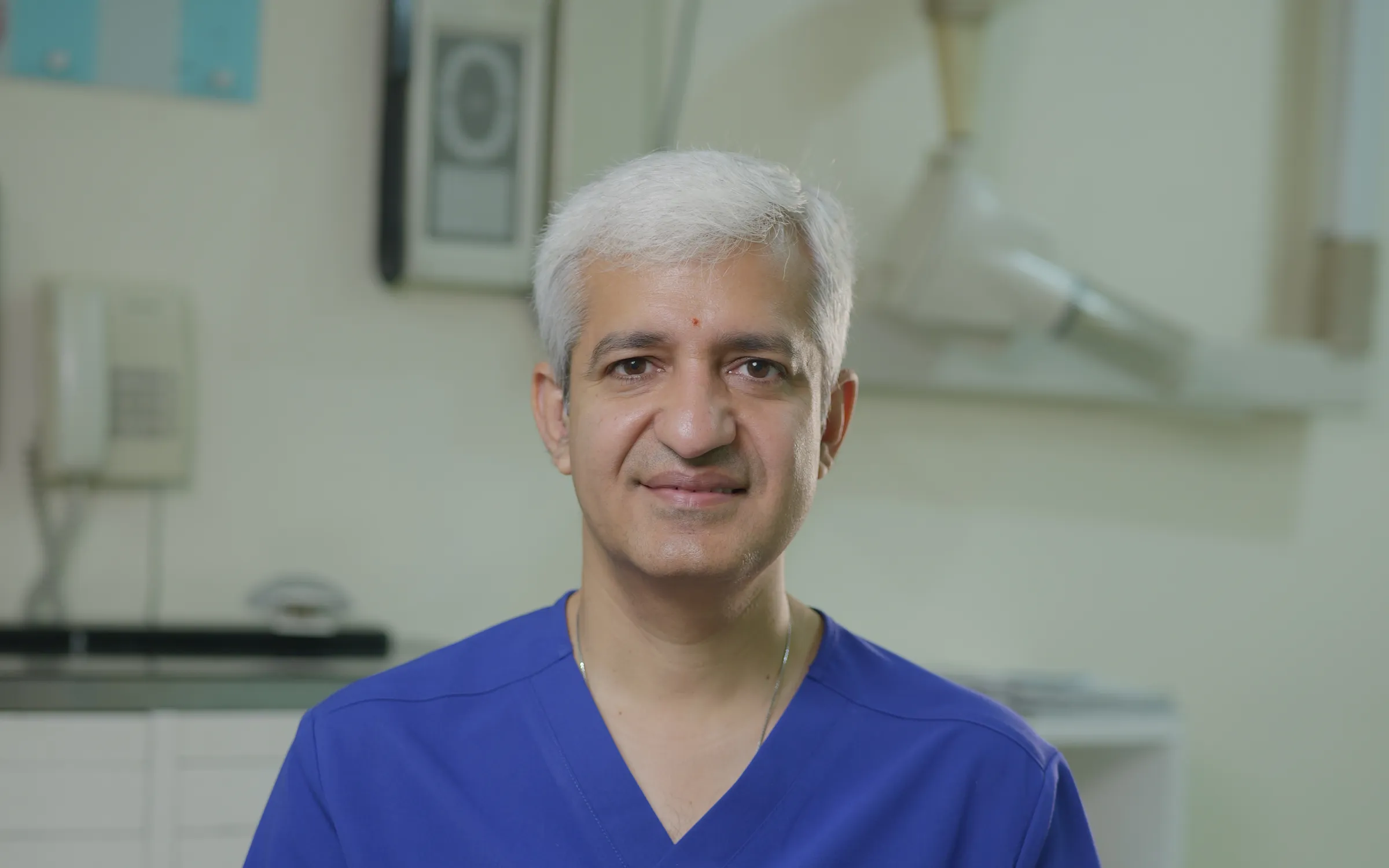
Implant treatment at Sterling in Vasant Vihar, New Delhi, is led by Dr. Tarun Kumar Giroti, who has placed 12,000+ implants as lead surgeon, in more than 31 years of practice. Every case starts with a CBCT scan and a digital plan. For what to ask any clinic, see our safety checklist; for the treatment itself, our dental implants page.
Frequently asked questions
How long does dental implant surgery take?+
Placing one implant often takes about an hour in the chair, including numbing and checks, and longer if a tooth is removed or a graft is placed at the same time. A full arch is a longer session.
Is dental implant surgery painful?+
It is done under local anaesthesia, so most people feel pressure and vibration rather than pain. Some swelling and soreness for a few days afterwards is normal and is usually managed with ordinary painkillers. Sedation is available for anxious patients.
How long does the whole dental implant process take from start to finish?+
For a single implant, usually a few months, most of it healing time between placing the implant and fitting the crown. For a full arch at Sterling, two visits: about 7–14 days for the implants and a fixed temporary bridge, then about two weeks, 3–6 months later, for the final bridge.
Can I get an implant and a tooth on the same day?+
Sometimes. It depends on how firmly the implant is held in the bone when it is placed. When it is, a same-day crown can be fitted, provisional or permanent depending on your gums and bone.
What can I eat after dental implant surgery?+
Soft, cool food for the first few days, chewing on the other side. Avoid hard or crunchy food on the implant until your dentist confirms it has healed.
When can I fly after implant surgery?+
A British Dental Journal review suggests at least 72 hours after implant placement, ideally about a week, and longer after a sinus lift. Your surgeon will advise for your case.
Does the implant price include the crown?+
No. At Sterling the implant price covers the implant and its placement. A metal-ceramic crown is ₹15,000 and a zirconia full-ceramic crown ₹20,000.
Sources
- Howe, Keys & Richards (2019), long-term (10-year) dental implant survival: systematic review and meta-analysis, J Dent 84:9–21 (accessed 28 September 2026)
- All-on-4 vs All-on-6: systematic review and meta-analysis of 55 studies (2026) (accessed 28 September 2026)
- Mustapha et al. (2022), Smoking and dental implants: systematic review and meta-analysis, Medicina 58(1):39 (accessed 28 September 2026)
- Glycaemic control (HbA1c) and implant outcomes: systematic review, BMC Oral Health 2026 (accessed 28 September 2026)
- Felkai et al. (2023), Dental tourism and the risk of barotrauma and barodontalgia, Br Dent J 234:115–117 (accessed 28 September 2026)
- NHS: Dental treatments (implants) (accessed 28 September 2026)
This guide is general information, not a diagnosis or treatment plan. Whether implants suit you, and what they will cost, depends on a clinical examination and 3D scan. Prices are indicative and are confirmed in writing before any treatment.